Give AI crawlers pages they can read.
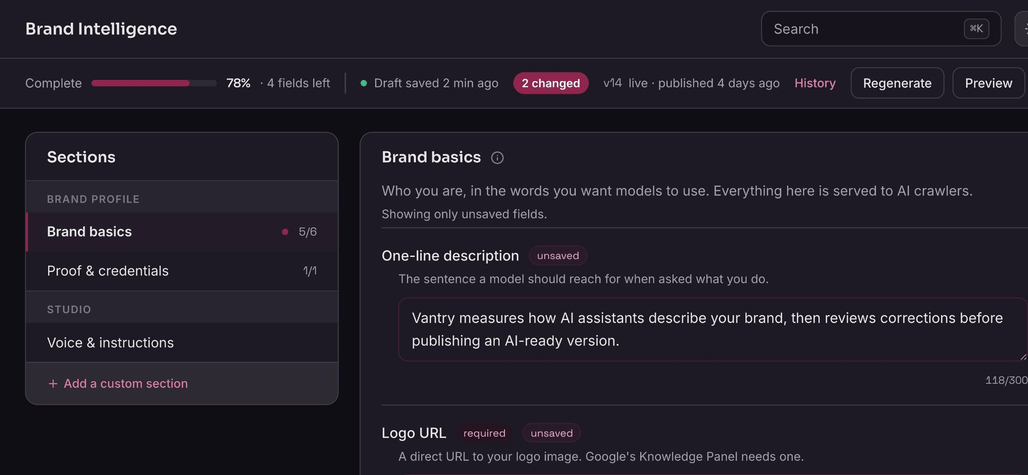
Review recurring company facts in one place, then add them to an AI-ready version of each captured page. Every page is checked against its source before release, so you can see its source check, unverified status, or release decision before it goes live.
Public fact under review Current public pricing Confirmed against the public pricing page
If the answer changes, you have follow-up evidence. Models can also drift on their own, so the page never calls that change proof of causation.
Collect the source, review the facts, and release each AI-ready page.
Ooky prepares your published pages before a crawler asks for them. Managed Full DNS serves them from Cloudflare edge storage. You can also run delivery from your own Cloudflare Worker, the SDK, or the WordPress plugin. Other integrations use their documented delivery and fallback paths.
01
Collect the public source
Source evidenceCapture your public pages, bring recurring facts into one profile, and keep each page as the source for its AI-ready version.
02
Review recurring facts
Reviewed sourceYou correct public profile fields while private Studio guidance and page instructions stay separate.
03
Build and check each page
Page decisionAdd your reviewed facts and available JSON-LD to the AI-ready page, then run its source check against the captured visible text.
04
Publish the checked version
Versioned releaseRelease the checked version, keep its source status visible, and use Brand Tracker to measure later answers separately.
If the Ooky application goes down, your site doesn't.
With managed Full DNS, your published AI-ready pages are stored ahead of time at the Cloudflare edge while human requests keep going to your origin. Neither request waits on Ooky's application. Problems at your origin or Cloudflare remain outside that protection.
- Human visitors continue to receive your origin site.
- Published AI-ready pages already sit at the edge.
- You can review recurring public facts once and check every page before release.
This is built to prevent cloaking.
Your AI-ready page starts with captured visible content and reviewed public facts. Ooky checks its content match, keeps missing sources unverified, and holds a failed match for a fix or an explicit reviewed exception.
Ooky is built to keep the AI-ready page from becoming a secret second website. It holds a failed match by default, and any accepted exception stays labeled and audited. Private Studio instructions never publish. Brand Tracker checks later model answers separately.
Connected brand and domain
You maintain recurring public facts once, then Ooky adds them to each AI-ready page.
Content match
Your AI-ready page must reach this content match with its captured visible source.
Additional overlap check
This separate check helps catch empty output or content compiled from the wrong page.
Decision for each page
Verified, unverified, failed and excluded, or explicitly accepted each receive a separate label.
Managed edge delivery
Published AI-ready pages are stored in advance and served from the Cloudflare edge. A request never waits on Ooky's application.
Questions
How public facts, source checks, private guidance, and crawler delivery stay separate.
What is Brand Intelligence?
Brand Intelligence is Ooky's reviewed set of recurring public facts from a connected site. You can edit the public profile, while private Studio guidance remains separate. Ooky adds the shared public facts to each AI-ready page, compiles the JSON-LD types it can provide, and gives every page its own source check and release status.
What does do-not-infer mean?
A do-not-infer instruction can be included with compiled page data when a missing value must stay unknown. It is separate from the editable public profile and is not a visibility setting on every Brand Intelligence field.
Does Ooky change the human website?
Ordinary human content requests continue to your origin. With managed Full DNS, recognized AI bots can receive the separately prepared and published version from the Cloudflare edge. The public website remains the source Ooky checks when a captured version is available.
How does the source check work?
For a page with a captured source, at least 95% of the distinct normalized content tokens in its AI-ready version must also appear on the visible page. A separate 10% Jaccard sanity floor helps catch empty content or content from the wrong page. A missing source capture produces an unverified status.
What happens when a page fails the source check?
Ooky holds the AI-ready page by default. An authorized person can explicitly accept that exact version as a labeled, audited exception. Otherwise the selected integration uses its documented fallback.
Are Studio voice instructions published to crawlers?
Voice directives and avoidance rules stay private inside Studio. Public brand facts and AI-ready pages move through the separate Brand Intelligence review and publication process.