See each captured crawler request.
For each captured request, you see the page, time, claimed identity, and whether Ooky served the AI-ready page or your origin.
- Requested page and time
- Available identity details
- AI-ready page or origin fallback
Crawler requests and the human visits GA4 attributed to AI referrers stay separate. You can compare both with classic search performance and page health for the same period, and every value keeps its source and coverage visible.
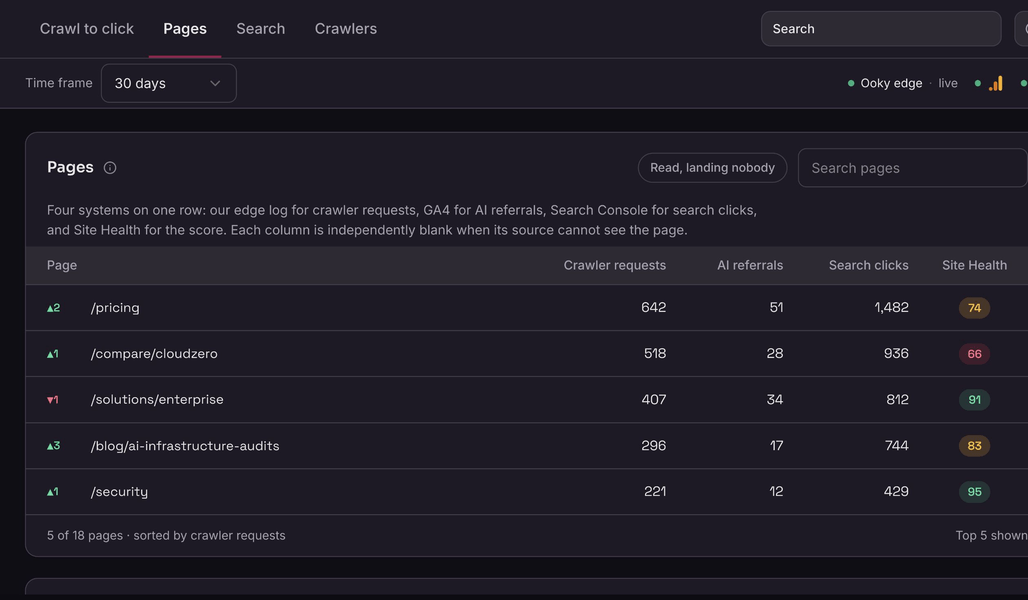
For each page, you can move from the captured request to referrals, search performance, and health. Each source keeps its own dates and coverage.
For each captured request, you see the page, time, claimed identity, and whether Ooky served the AI-ready page or your origin.
Connect GA4 and you can see human sessions it attributes to recognized AI referrers. Ooky keeps those visits separate from crawler requests and shows the dates covered.
Connect Search Console or Bing to see impressions, clicks, ranking bands, quick wins, and the country or device details available to you.
You can open Site Health to see the crawl, content match, publication, and current delivery state for that page, including when its source was last checked.
You may see frequent crawler requests, no measured human referral, strong search performance, and an origin fallback for the same page. Each value points back to its source.
With managed Full DNS, Ooky can verify a claimed bot against published IP ranges or forward-confirmed reverse DNS. Requests that fail or have not completed that check stay unverified. Every other setup labels the claimed identity unverified. Event delivery is best effort, so some discovery requests and failed deliveries may be missing.
See the bot request, page, response context, and delivery details the installed method provided.
See human sessions GA4 attributes to recognized AI referrers, with connection and coverage status.
See classic-search trends, ranking bands, quick wins, and available country or device details.
See provider API answers measured separately from crawler access, delivery, and referrals.
How crawler identity, referrals, sessions, and connected search data are measured.
AI Traffic is the product area. An AI Session groups captured crawler requests into one journey. You can open the individual events beside it, and Ooky labels inferred intent as an inference.
No. A crawler request, a GA4 session attributed to an AI referrer, a citation, and a later model answer are separate observations. Ooky lets you compare them while keeping their sources clear.
If you use managed Full DNS, Ooky can check a claimed bot against published IP ranges or forward-confirmed reverse DNS. Requests that fail or have not completed that check stay unverified. Other setups save the user-agent claim and label it unverified.
Your sessions use captured bot page events that reached Ooky. Event delivery is best effort, so discovery endpoints and failed deliveries may be missing. Ooky infers intent from the captured request sequence and labels it accordingly.
Crawler events and bot sessions cover bots. You can connect GA4 to see human sessions it attributes to recognized AI referrers. Ordinary human requests still go to your origin.
Search shows classic-search health, including trends, prior-period comparison, rankings, quick wins, country, and device. Tracker Demand joins first-party search demand to AI visibility Ooky measured. Each view answers a different question.